
This spring, HubSpot rolled out Breeze AI across its platform. The pitch is straightforward: ask a question about your CRM data in plain English and get a useful answer. If you run a Revenue Operations (RevOps) team already on HubSpot, the reasonable follow-up question is whether this makes a separate AI data layer redundant.
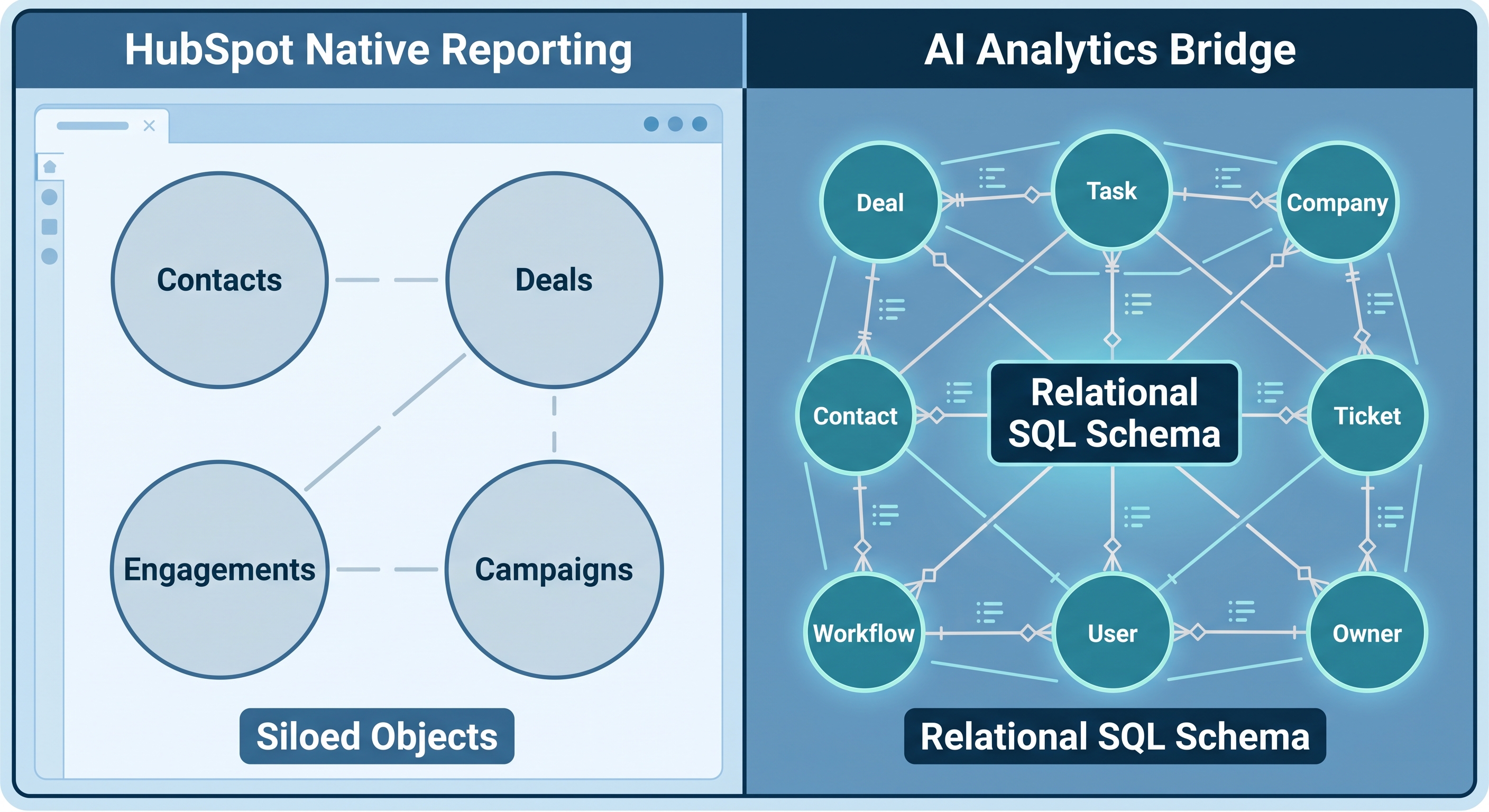
The short answer is no, and the reason is architectural. Breeze AI is a real product with genuine utility for contact research, email drafting, and plain-English summaries of pipeline activity. But every analytical question it answers goes through the same reporting infrastructure HubSpot dashboards use. That infrastructure has a defined ceiling: one object type per query, no joins, no window functions, no Common Table Expressions (CTEs), and no aggregate-of-aggregates. Breeze AI inherits those constraints. The conversational interface changed. The data layer underneath did not.
This post covers three specific revenue questions that expose that ceiling, and explains why a SQL data layer is the structural fix rather than a better user interface.
The Single-Object Reporting Ceiling
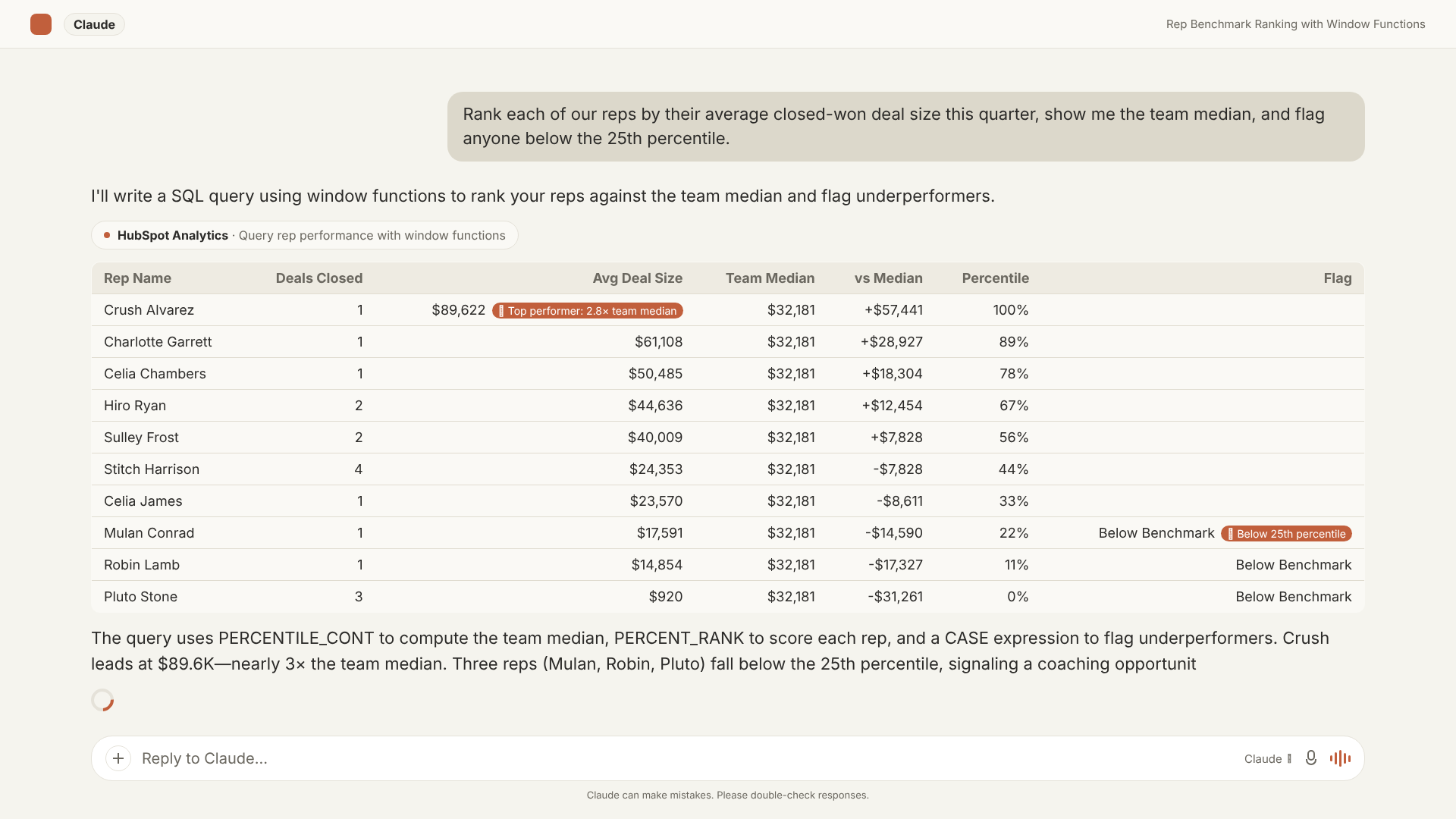
HubSpot's reporting model is built around individual object types. A deal report queries deals. A contact report queries contacts. Even in Enterprise, cross-object reporting uses dot-notation access across a limited number of associated objects, and it does not support joins across three or more entities, CTEs, window functions, or aggregate-of-aggregates. A question like "rank each rep by their average closed-won deal size and flag anyone below the team's 25th percentile" requires computing an aggregate and then ranking against it: two levels of aggregation the single-object model cannot express in one query.
Breeze AI is built on top of this model. When you ask it which reps are underperforming on deal conversion, it generates a response using the same object-scoped queries the dashboard would run. It can surface that information more conversationally. It cannot restructure the underlying query to compute logic the data layer does not support.
That ceiling matters most in three scenarios that come up in every revenue and finance review.
Scenario 1: Pipeline Values That Look the Same but Are Not
Every HubSpot pipeline stage has a single configured win probability. A deal in 'Proposal' at 70% contributes deal value multiplied by 0.70 to weighted pipeline, for every rep, in every quarter. That number is the same regardless of what a rep actually had to see before advancing the deal.
The problem is that 'Proposal' means different things to different reps. One rep advances a deal the moment any client email arrives. Another advances only after a live call that signals real buying intent. Both show 'Proposal' in HubSpot. Both get weighted at 70%. The number the forecast reflects is the configured probability, not each rep's actual closing probability from that stage.
Here is an illustrative scenario showing what correcting for this looks like. Rep A has 18 open Proposal deals worth $1,240,000. At the configured 70% weight, his pipeline reads $868,000. But his own historical win rate out of the Proposal stage is 25%. Correctly weighted, his pipeline is worth $310,000.
Rep B has 6 open Proposal deals worth $520,000. At 70%, her pipeline reads $364,000. But her actual win rate out of Proposal is 85%. Correctly weighted, her pipeline is worth $442,000.
Rep B's correctly weighted pipeline is $132,000 higher than Rep A's, even though she has fewer deals and lower total face value. Any reporting tool, with or without an AI layer on top of it, weights both reps' deals identically at 70%. Computing the correct number requires knowing that two reps use the same stage label to mean different things, and no off-the-shelf reporting system, whether it is HubSpot native, an external Business Intelligence (BI) tool, or a dashboard with an AI front end, has anywhere to record that kind of tacit, per-person behavioral context.
The mechanism that makes the correction possible is semantic metadata. A user tells the AI, in plain English, that Rep A advances on any email while Rep B advances only after a call. The AI saves that as a durable note attached to the schema, indexed so it resurfaces on every future schema exploration. Every future query accounts for this context automatically. The correction does not have to be repeated.
Scenario 2: The Margin Decline That Was Not a Business Event
HubSpot portals accumulate custom properties over time. What a field means when it is created is not always what it means a year later, and there is no schema record of those changes.
Consider a custom deal property called raw_cost. When the team created it, the field tracked cost of goods sold (COGS) only. Starting in Q2 of this year, the team began folding one-off logistics and freight costs into the same field. The column name never changed.
Here is an illustrative scenario showing what this looks like in a margin trend. Margin as recorded reads 61.2% in Q4 2025, 60.8% in Q1 2026, then drops to 52.1% in Q2 2026 and 51.4% in Q3 2026. That nine-point decline over two quarters looks like a pricing problem, a cost issue, or a product mix shift. Every reporting tool that subtracts the raw_cost field from deal amount uniformly across all time periods shows that drop.
The corrected trend, adjusted for the field redefinition, is flat: 61.2%, 60.8%, 60.5%, 60.1%. The apparent margin crisis was an accounting artifact from the definition change, not a business event.
The correction mechanism is the same as in Scenario 1. A user tells the AI once that raw_cost only tracked COGS through Q1 2026, and that it includes approximately 9% logistics costs from Q2 2026 onward. The AI stores that note via the semantic metadata layer. Every future margin question it answers applies the time-bounded correction automatically, and the adjusted SQL is shown with every answer so the correction is auditable rather than a silent adjustment hidden inside a calculated field.
Scenario 3: Booked Revenue vs Revenue Actually Collected
HubSpot 'closed-won' is an event a sales rep records. It is not a revenue fact. Whether a customer converted from trial to paid, whether their subscription is still active, refund history, and churn data all live in a billing system like Stripe. HubSpot's reporting has no visibility into any of them.
An AI with connections to both systems could, in principle, correlate the two. The historical obstacle on the HubSpot side has been the API: rate-limited, paginated, and slow at meaningful scale. Fetching a full quarter of deal data for cross-source comparison required many sequential API calls. Turning HubSpot into a queryable SQL database removes that obstacle by making the full dataset available as a single, fast query.
Here is an illustrative scenario. Across a sample of closed-won deals, $7,640,000 was recorded as booked revenue in HubSpot. Against those same deals, only $5,930,000 was actually collected in Stripe. The gap breaks into $540,000 in deals marked closed-won that never converted to a paid subscription, and $1,170,000 in deals that paid initially but have since churned.
At the rep level, the picture shifts significantly. One rep's HubSpot total looked strong at $1,910,000, but only $1,180,000 was actually collected, with $180,000 never paid and $210,000 already churned. Another rep's booked and collected figures nearly matched ($1,240,000 booked versus $1,205,000 collected), with zero unpaid conversions and only $35,000 in subsequent churn. The second rep is generating durable revenue. The first is partly generating CRM entries.
To be precise about how this works: the correlation between HubSpot and Stripe happens in the AI's reasoning layer, not in a single SQL statement that joins both databases. The AI queries each source separately and correlates the results. What the SQL layer contributes on the HubSpot side is the ability to run that side of the query as a fast, single-shot operation instead of a paginated API crawl across hundreds of sequential requests.

The Mechanism: A SQL Data Layer Plus Context Memory
DataLabs.store built AI Context Bridge for HubSpot to address this at the data layer, not the interface layer.
The architecture has two components. First, an OAuth-based sync pulls a HubSpot portal into a real Microsoft SQL Server database. The output is a normalized relational schema with proper foreign key relationships between deals, contacts, companies, pipeline stages, and associated objects. Not a flat export or a JSON snapshot.
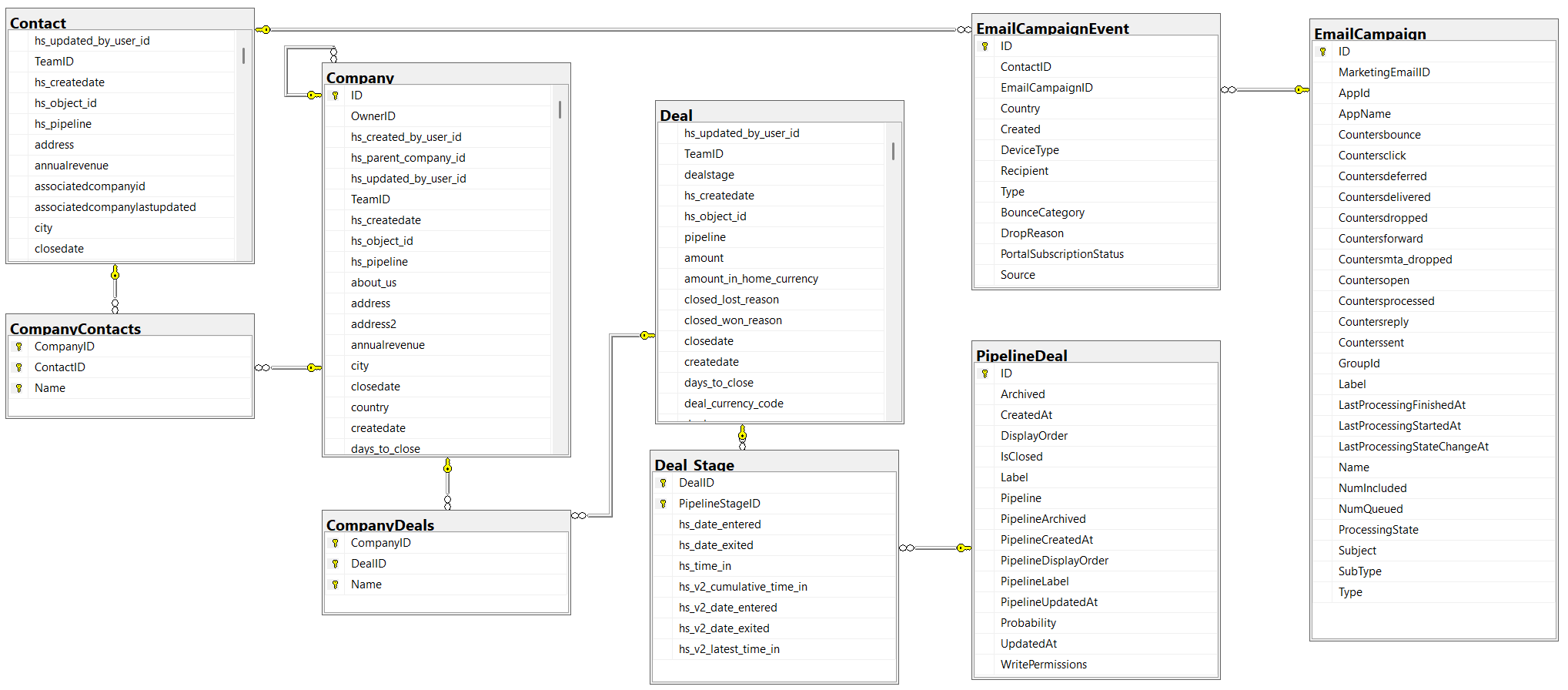
Second, a Model Context Protocol (MCP) endpoint exposes that database to Claude or ChatGPT. The AI can write real SQL against the full schema: joins across any number of tables, CTEs, window functions, aggregate-of-aggregates. Every query is shown with its result, so every answer is auditable.
The semantic metadata layer handles tacit business context that cannot be encoded in a column name or schema definition. Notes attached to schema objects are indexed and resurface automatically on every future schema exploration. A per-rep behavioral pattern, a field's historical definition change, any business rule a query needs to get right, can be recorded once and applied consistently going forward.
What Breeze AI Is Good For
This is not an argument that Breeze AI is without value. For content generation, automated contact research, email drafting, and plain-English summaries of individual object records, it works well and the native integration removes friction. The constraint is structural: when a question requires joining pipeline stage history to per-rep behavioral context, or comparing a trend against a field whose definition changed mid-year, or correlating booked deals against billing system outcomes, the question requires a data layer that can express relational logic. An AI layer on top of a single-object reporting engine cannot produce what the data layer below it cannot compute.
The Questions That Should Work, but Do Not
Here are the kinds of questions RevOps and sales leadership teams ask in every quarterly business review (QBR), and why HubSpot's native reporting cannot answer them regardless of what AI sits on top.
| Question | Why It Falls Outside the Single-Object Model |
|---|---|
| Which reps' pipelines are correctly weighted for their actual win rates, not the stage's configured probability? | Requires joining stage history to per-rep closed outcomes, computing historical win rates as an intermediate step, and applying those rates to open pipeline. That is an aggregate-of-aggregates with a join across multiple object types. |
| What was our gross margin trend last year, corrected for the custom field that changed definition partway through? | Requires time-bounded conditional logic on a field's meaning. No reporting tool stores a record of when a custom property changed its business definition. |
| How much of our closed-won revenue actually converted to active paid subscriptions and is still retained? | HubSpot has no visibility into billing system outcomes. Answering requires correlating CRM records against payment data from another system. |
| Which open deals have been sitting in their current stage longer than the median time our won deals historically spend there? | Requires computing a median stage duration across won deals first, then comparing open deals to that result. The median requires a window function; comparing to it is a second aggregation on that result. |
These are not exotic questions. They come up in every pipeline review and QBR. The gap between answerable and not answerable is not the intelligence of the AI. It is whether the data layer can produce the relational logic the question requires.
Ready to ask the revenue questions your HubSpot dashboards cannot answer?